Can AI in Defense Keep Militaries Faster and Still Ethical?
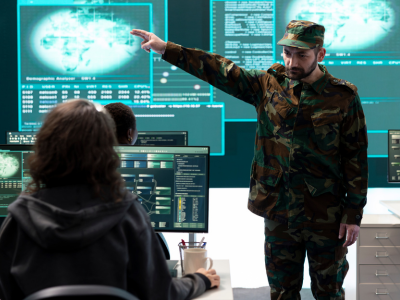
The modern battlefield is moving faster than human thought can follow. For decades, military leadership relied on steady intelligence and calculated maneuvers. However, in 2026, the sheer volume of data from satellites, drones, and sensors has created a “cognitive wall.” To break through, global powers are turning to a powerful ally. AI in defense is no longer a futuristic concept; it is the current backbone of national security. From identifying threats in seconds to optimizing complex supply chains, artificial intelligence is redefining what it means to be “battle-ready.”
But as algorithms take on more weight, a vital question remains. How do we harness this “decision advantage” without surrendering our human values? This playbook explores the official strategies and ethical guardrails that keep AI in defense both lethal and lawful.
Why AI in Defense Matters Now
AI in defense has shifted from experimental labs to active operational theaters. In 2026, militaries use these tools to fuse massive datasets and deter aggression. The U.S. Department of Defense (DoD) refers to this as “decision advantage.” By using AI, commanders can see through the “fog of war” with unprecedented clarity. This strategic shift is reflected in the industry’s rapid growth; recent research shows that the artificial intelligence in defense market size is projected to reach US$ 16.17 billion by 2031.
Furthermore, NATO updated its AI strategy in late 2024 to accelerate responsible adoption across all member nations. The goal is simple: maintain a technological edge while ensuring systems can talk to one another. Meanwhile, the UN is pushing for binding rules by late 2026 to ensure that humans, not machines, make the final call on the use of force.
What is the Official Policy Baseline for AI in Defense?
The DoD Path: Responsible AI at Scale
The 2023 DoD Data, Analytics, and AI Adoption Strategy serves as the primary blueprint for the United States. It focuses on diffusing AI across every mission, from the boardroom to the foxhole. Central to this is the Chief Digital and AI Office (CDAO), which provides the governance needed to keep projects on track.
The DoD doesn’t just want fast AI; it wants Responsible AI (RAI). This means every system must be:
- Lawful: Adhering to all international treaties.
- Accountable: Having a clear human chain of responsibility.
- Traceable: Allowing experts to understand how a machine reached a conclusion.
NATO and the UK: A Shared Ethical Standard
NATO’s revised strategy affirms six “Principles of Responsible Use.” These include bias mitigation and explainability. Similarly, the UK’s Defence AI Strategy emphasizes a safe and ambitious pathway. These policies ensure that Allied forces remain interoperable and ethically aligned during joint missions.
What Problems Does AI in Defense Actually Solve?
1. Faster Decisions from Complex Data
Modern sensors produce more data than any human team can analyze. GEOINT AI (Geospatial Intelligence) now handles the “heavy lifting.” The National Geospatial-Intelligence Agency (NGA) uses AI to triage imagery, allowing analysts to focus only on the most critical threats.
2. Enhanced Targeting and “Project Maven”
One of the most famous examples is Project Maven. This initiative uses computer vision to spot objects in full-motion video. By automating target detection, it reduces the workload on operators and improves the precision of strikes, potentially saving civilian lives by reducing errors.
3. Composable Operations and Mosaic Warfare
DARPA has pioneered the “Mosaic Warfare” concept. Imagine a battlefield made of individual “tiles”, sensors, drones, and shooters. AI acts as the glue, coordinating these tiles into a resilient “effects web.” This makes the military harder to hit and much faster to respond.
What Are the Biggest Risks of AI in Defense?
The Danger of Autonomy Without Control
The ICRC (International Committee of the Red Cross) warns that fully autonomous weapons pose grave legal risks. If a machine misidentifies a civilian convoy as a military target, who is to blame? This “accountability black hole” is a major concern for 2026.
Workforce and Talent Gaps
Having great tech is useless without the right people. A recent GAO report found that the DoD needs to better define its AI workforce. Militaries must train a new generation of “digital warfighters” who understand both the code and the combat.
How Do Militaries Deploy AI in Defense Responsibly?
Militaries are building “trust architectures” to prevent accidents. The CDAO sets enterprise standards that every AI project must follow. This includes rigorous TEV&V (Testing, Evaluation, Verification, and Validation).
DARPA’s ACE Program is a perfect example. It uses AI in high-speed “battles” to see how well humans and machines work together. The human remains the mission commander, while the AI handles the split-second flight maneuvers. This keeps the human “in the loop” for the big decisions.
Concrete Use Cases from Official Sources
- ISR (Intelligence, Surveillance, and Reconnaissance): AI speeds up the analysis of drone feeds to find hidden threats.
- Command and Control: The Air Force uses AI to automate parts of the “kill chain,” making targeting more accurate.
- Predictive Maintenance: AI predicts when a tank or jet will break, saving millions in repair costs.
- Cyber Defense: AI monitors military networks 24/7 to stop hackers before they breach the system.
How Does Policy Keep AI Aligned with Law and Ethics?
The UN General Assembly is working toward a binding instrument by the end of 2026 to govern lethal autonomous weapons. This effort, supported by the ICRC and over 120 nations, aims to ensure machines never have the final say over human life. Current International Humanitarian Law (IHL) already applies to these technologies, as law is considered “technologically neutral.”
Militaries must ensure every new system can make clear distinctions between combatants and civilians. They must also apply the principle of proportionality, ensuring that any automated action does not cause excessive incidental harm. By embedding these legal guardrails into the software itself, nations can innovate rapidly without losing their moral compass. This “ethics-by-design” approach ensures that even as the speed of war increases, human accountability remains the ultimate priority.
Actionable Checklist: Building Trustworthy AI in Defense Programs
- Tie Governance to the Mission: Align every project with the CDAO frameworks.
- Keep Humans in Command: Map exactly where a human must intervene in the decision process.
- Prioritize Data Quality: Ensure your data is “clean” to avoid algorithmic bias.
- Adopt NATO’s TEV&V Mindset: Test your systems in “sandboxes” before deploying them to the field.
- Close the Talent Gap: Create clear career paths for AI experts within the military.
- Communicate with Transparency: Use public-facing policies to build trust with the citizens you protect.
Final Take
In 2026, AI in defense has transitioned from a tactical advantage to a strategic necessity. While superior hardware remains important, the real “decisive edge” comes from how seamlessly we integrate intelligence into existing force structures. By adhering to the rigorous ethical playbooks established by the DoD, NATO, and the UK, modern militaries ensure that speed never comes at the cost of safety or international law.
The leaders of tomorrow are not those with the most data, but those who master smarter integration. By prioritizing solid governance and human-centric design, nations can foster the trust required to deploy autonomous systems effectively. Ultimately, keeping humans in the loop ensures that as our technology grows more sophisticated, our moral and strategic accountability remains absolute.