Microsoft Wikipedia AI agreement ignites a rethink of data access.
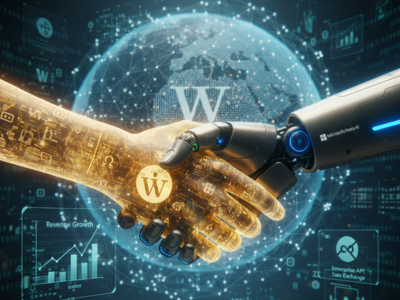
The Wikimedia Foundation moved decisively to modernize data access for AI companies. It unveiled paid partnerships with Microsoft, Meta, Amazon, Perplexity, and Mistral AI. The framework extends an agreement with Google announced in 2022, the Microsoft Wikipedia AI agreement. Consequently, major firms will shift from broad scraping to enterprise feeds. Moreover, the approach targets sustainability, reliability, and transparent cost sharing. Meanwhile, Wikipedia’s global volunteer community continues to maintain and improve content.
Wikipedia’s scope remains extraordinary and uniquely useful. It hosts more than 65 million articles in over 300 languages. Therefore, developers treat it as a cornerstone dataset for training models. However, unrestricted scraping has amplified server costs and instability. Furthermore, bursts of automated traffic degrade performance for human readers. Thus, structured access promises steadier throughput and consistent formats. In parallel, Wikimedia gains funding aligned with actual consumption.
Lane Becker, who leads the enterprise unit, outlined the value proposition. He said customers wanted clean, versioned data and dependable uptime. Additionally, they needed guidance for integration and change management. Therefore, the new services include SLAs, documentation, and support. In turn, AI teams can synchronize training cycles with predictable updates. Likewise, the Foundation can plan capacity upgrades with clearer revenue signals.
Microsoft emphasized the importance of trustworthy sources for AI safety. The company said curated and verifiable content improves downstream reliability. Accordingly, the partnership formalizes responsible pipelines over uncontrolled scraping. Moreover, it validates a collaborative model for open knowledge at scale. Consequently, both parties share incentives to preserve quality and availability. Notably, the Microsoft Wikipedia AI agreement reflects a maturing data market. It encourages firms to pay for dependable, ethical inputs.
Meta’s involvement reinforces multilingual priorities across its research and products. Its models require breadth, depth, and consistent editorial practices. Therefore, volunteer-maintained pages meet those needs with linked references. Additionally, Perplexity and Mistral AI benefit from standardized refresh intervals. Thus, they can benchmark improvements against reproducible snapshots. Meanwhile, Amazon leverages structured access for assistants and search features. Altogether, these relationships highlight convergence on responsible data sourcing.
Jimmy Wales publicly welcomed AI training under fair terms. He argued that human-curated knowledge yields better model behavior. However, he insisted that companies must help cover operating costs. Therefore, licensing supports servers, tooling, and community initiatives. Moreover, it deters covert scraping that burdens infrastructure without accountability. In essence, the model blends openness with pragmatic stewardship. It protects free reading while asking industry users to contribute.
Shifting traffic patterns also influenced this strategy. Human visits dipped as AI summaries reduced click-through behavior. Consequently, bot activity rose and sometimes masked itself. Thus, enterprise channels separate authorized high-volume access from gray‑area harvesting. Additionally, they offer technical guidance and change notices for smooth adoption. Therefore, customers can plan pipelines without unexpected slowdowns. Meanwhile, editors gain more stable tools and faster maintenance cycles.
Wikimedia continues exploring assistive AI for routine tasks. Potential tools could repair dead links or surface citation candidates. Furthermore, machine suggestions might triage vandalism and support backlog cleanup. However, editors would approve and finalize all changes. Consequently, human judgment remains central to quality control—likewise, transparent logs and community oversight guide deployments. Ultimately, the goal pairs efficiency with integrity across workflows.
Leadership transition aligns with these operational changes. A new chief executive will oversee partner relations and product roadmaps. Accordingly, the Foundation will refine pricing, tiers, and data formats. Moreover, it will clarify provenance reporting and update cadence. Consequently, enterprises can map training calendars to reliable snapshots. In return, Wikimedia can invest in capacity and community resilience. The feedback loop strengthens both infrastructure and editorial collaboration.
Observers will scrutinize fairness, access, and long-term governance. They will ask how smaller players can participate sustainably. Nevertheless, the core principle remains straightforward and credible. Heavy users should help fund the systems they rely on. Therefore, the Microsoft Wikipedia AI agreement represents a responsible precedent. It converts unmanaged scraping into accountable, supported access. Furthermore, it reduces wasteful traffic while improving data quality. In sum, the arrangement aligns mission, market, and technology.
The broader impact extends beyond the signatories. Developers gain reliable inputs and clearer provenance. Meanwhile, readers benefit from a more robust public resource. Additionally, volunteers receive improved tools and steadier infrastructure. Thus, collaboration replaces friction in the data commons. The Microsoft Wikipedia AI agreement highlights that shift with practical terms. It proves that open knowledge and fair monetization can coexist. Ultimately, this model secures continuity for a vital global reference. Consequently, it guides other stewards toward similar balanced solutions.