Illegal Migrants Fueling Illegal Employment in UK Mini-Marts
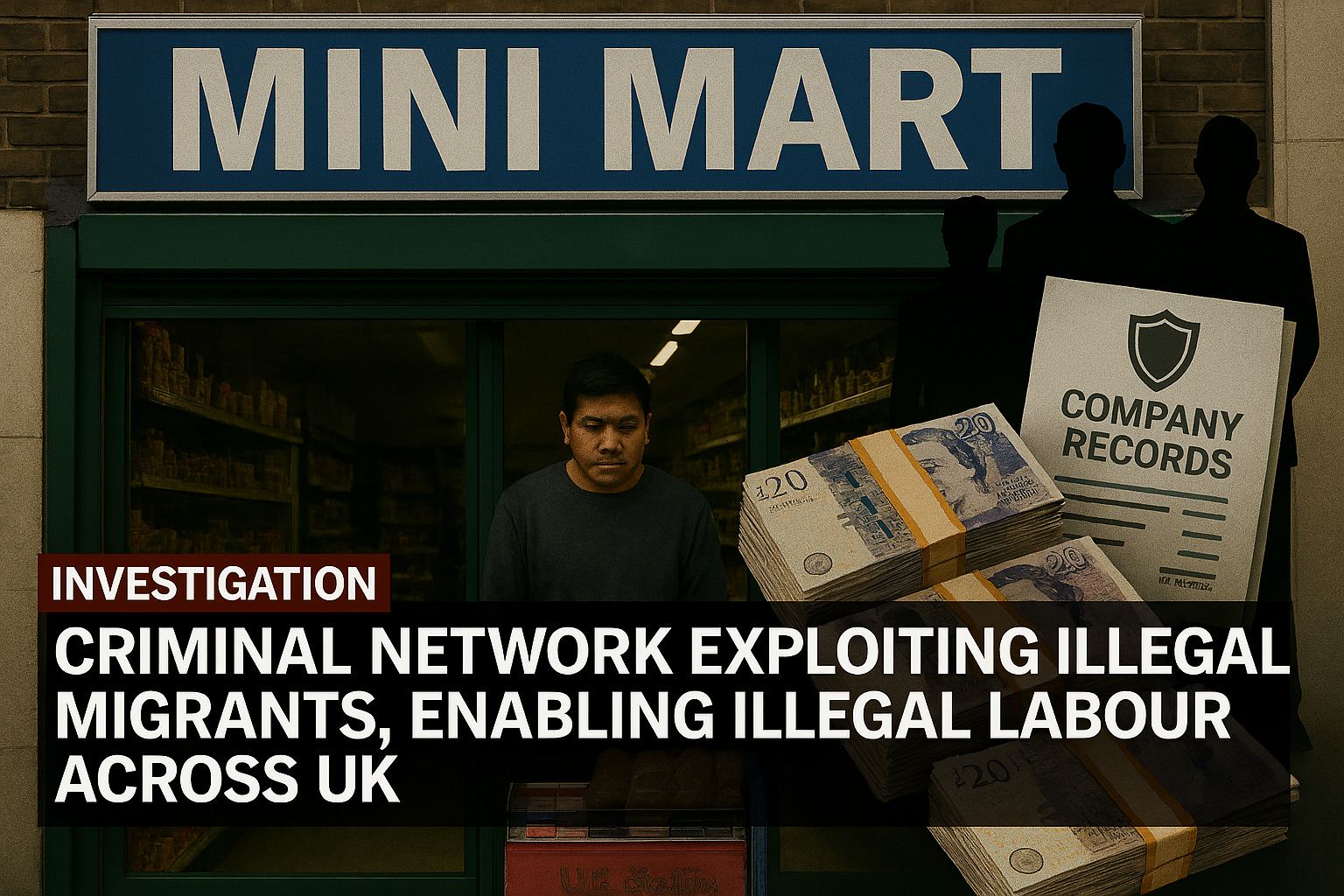
Recent investigations reveal that organised crime networks in the UK are systematically exploiting mini-marts to employ Illegal Migrants. These shops appear legal and operational on the surface, but criminal operators secretly control them. To reduce costs and boost profits, the operators hire individuals without work permission, often sacrificing safety, labour rights, and fair business practices.
The operators register many mini-marts under front directors; they pay these individuals nominal fees simply to use their identities. The real controllers operate behind the scenes, installing Illegal Migrants in key roles. They often lure workers with promises of legalisation or permanent employment, but those claims rarely prove true.Consequently, they face unsafe working conditions, long hours, and inadequate pay, often with no legal protection.
The network exploits gaps in enforcement. Weak company registration rules and limited labour inspections in small retail shops enable this activity. Operators further conceal illegal employment through informal agreements and cash payments. They routinely place Illegal Migrants across multiple shops, sometimes having them live in or near their workplaces to ensure constant availability. Furthermore, the operators sometimes use these businesses to launder money, which compounds the difficulty for authorities trying to trace illegal activities.
Authorities have historically focused enforcement on high-profile sectors like construction, hospitality, and delivery services. Mini-marts, however, have emerged as a low-visibility yet highly profitable channel for criminal networks. The criminal controllers rotate shop names, directors, and locations often to keep authorities from detecting their scheme.This flexibility enables operators to employ Illegal Migrants widely while keeping them trapped in exploitative work environments.
The human impact is profound. Illegal Migrants face severe exploitation, working long hours for minimal pay while being denied fundamental rights. Many depend on criminal operators for accommodation and necessities, creating a cycle of fear and dependency. Workers often refrain from reporting abuses due to the threat of deportation or retaliation, allowing operators to continue profiting from their labour with little oversight.
Economic repercussions are significant. Shops employing Illegal Migrants undercut lawful competitors, distorting the labour market and creating unfair competition. Tax revenue is lost, and legitimate businesses struggle to remain profitable. Public safety is also at risk, as some mini-marts fail to meet hygiene or operational standards. This exploitation undermines trust in both local businesses and regulatory enforcement mechanisms.
Government and law enforcement agencies are implementing more comprehensive measures. Legislation now targets those facilitating illegal employment, while enforcement efforts focus on dismantling organisational networks rather than punishing individual workers. The goal is to address structural exploitation and prevent criminal networks from continuing their operations unchecked.
Authorities are coordinating with immigration, labour, and financial enforcement agencies to detect and disrupt illegal employment schemes. They aim to reduce the inflow of Illegal Migrants into these networks and protect those already exploited. Awareness initiatives are being launched to educate vulnerable workers about the risks of illegal employment and the deceptive tactics used by criminal networks. Financial investigations are underway to trace hidden profits and recover lost tax revenue.
Community organisations and NGOs are actively assisting Illegal Migrants, providing legal support, temporary shelter, and advocacy. These groups play a crucial role in helping workers escape exploitation and provide evidence for investigations. Their participation highlights the necessity of multi-agency collaboration to address the issue effectively.
In conclusion, UK mini-marts are being used by organized crime networks to employ Illegal Migrants illegally. This exploitation damages workers, disrupts fair business practices, and deprives the government of tax revenue. Authorities stress the importance of robust legal reforms, strategic enforcement, and coordinated disruption of criminal networks. Without decisive intervention, the employment of Illegal Migrants in mini-marts will persist, perpetuating abuse, economic unfairness, and systemic exploitation. Comprehensive action is essential to protect vulnerable workers and restore integrity to the UK retail sector.