Are Embedded Processors Finally Leading a Tech Comeback?
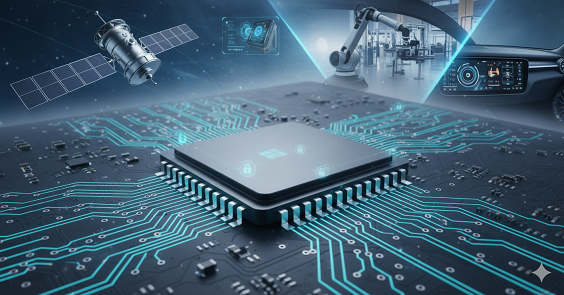
Embedded processors, those small but powerful chips that live inside everything from smartphones to spacecraft, are quietly leading a technological revolution in 2025. Once considered niche components used mainly in industrial or specialized applications, embedded processors are now recognized as vital engines of innovation, national security, and economic competitiveness.
From enabling autonomous spacecraft and smart factories to powering critical medical devices and AI-driven defense systems, it is increasingly being treated not just as technological tools, but as strategic infrastructure.
This transformation is being fueled by a convergence of government initiatives, private sector investment, and breakthroughs in chip design. Major developments, ranging from NASA’s advancements in space-grade systems to massive funding from the CHIPS and Science Act, signal a new era in embedded computing.
NASA’s Space-Grade Embedded Processors
NASA’s latest report on Small Spacecraft Avionics reveals how embedded processor technology is advancing to meet the rigorous demands of space exploration. These chips are being designed to operate in the harshest environments imaginable, where extreme temperatures, radiation, and power constraints would cripple conventional electronics.
Key Innovations Include:
- Radiation-Hardened Embedded Processors:
NASA’s new-generation processors are engineered to withstand high levels of cosmic radiation and solar flares, which can corrupt data or disable critical systems. These chips ensure mission continuity even in deep space. - System-on-Chip (SoC) Architectures:
By integrating processing, memory, communication, and control into a single, compact chip, NASA reduces the Size, Weight, and Power (SWaP) profile of spacecraft. These SoCs are more efficient, lighter, and better suited for long-duration missions. - Advanced Command and Data Handling (CDH) Systems:
Embedded processors are becoming the “brains” of spacecraft, handling real-time decision-making, autonomous navigation, and onboard telemetry without needing constant input from Earth.
While these innovations are designed for space, they’re also finding terrestrial applications. Earth-based systems like satellite communication, remote sensing, and disaster monitoring benefit from the same embedded technologies, demonstrating the dual-use potential of NASA’s research.
CHIPS and Science Act
The CHIPS and Science Act of 2022 has become a catalyst for reshoring semiconductor manufacturing and securing America’s place in the global chip supply chain. In 2025, the Department of Commerce reported over $30 billion in private sector investments across 23 major semiconductor projects in 15 U.S. states.
Embedded Processor Highlights:
- 16 New Manufacturing Facilities:
Many of these fabs are specifically geared toward producing embedded processors for sectors such as automotive, consumer electronics, healthcare, and industrial automation. - Strategic National Goal:
The U.S. aims to produce 30% of the world’s leading-edge chips by 2032, a leap from 0% in 2021. Embedded processors are central to achieving this ambition. - Resilient Supply Chains:
As the world learned during the pandemic-era chip shortages, embedded processors are essential to everything from ventilators to tractors. Reducing dependence on foreign suppliers is now a national security priority.
Importantly, this investment wave isn’t just about producing more chips, it’s about making smarter chips. Embedded processors being developed today include features like AI acceleration, secure boot, and low-power operation, making them more versatile and secure than ever before.
Texas Instruments Expansion
As part of the CHIPS Act’s rollout, the Biden-Harris Administration announced $1.6 billion in proposed funding for Texas Instruments (TI) to build three new fabrication facilities in Texas and Utah.
TI is a global leader in analog and embedded processing, and this expansion is expected to significantly strengthen domestic supply chains.
TI’s Strategic Objectives:
- Current-Generation & Mature-Node Chips:
TI specializes in microcontrollers, digital signal processors (DSPs), and power management ICs, key building blocks of modern embedded systems. - Dual-Use Applications:
TI chips are used in both civilian and military technologies, from smart thermostats and wearable devices to missile guidance systems and encrypted military radios. - Workforce Development:
TI’s expansion includes dedicated training programs aimed at building a pipeline of engineers and technicians, ensuring that America’s embedded processor ecosystem has the talent it needs to grow.
These investments make it easier for startups, OEMs, and universities to access advanced embedded processing capabilities, democratizing innovation across the country.
Department of Defense: $269M for Embedded Processor R&D
Embedded processors are also playing an increasingly important role in the defense sector. Under the Microelectronics Commons (ME Commons) program, the Department of Defense (DoD) awarded $269 million in 2025 to fund 33 research projects focused on next-generation microelectronics.
Key Embedded Processor R&D Areas:
- Secure Edge Computing:
Developing chips that perform AI-driven tasks locally, without relying on cloud infrastructure, ideal for remote battlefields, drones, and reconnaissance missions. - AI-Powered Embedded Systems:
Integrating machine learning into processors allows for real-time threat detection, predictive maintenance, and autonomous navigation. - Defense-Grade Reliability:
These chips must function under extreme heat, vibration, and electromagnetic interference while maintaining near-zero failure rates.
This initiative ensures the U.S. military maintains technological superiority and reduces its reliance on foreign components in mission-critical systems.
Why Embedded Processors Matter More Than Ever in 2025
In 2025, embedded processors are emerging as the unsung heroes of modern technology. Their importance spans nearly every industry and application imaginable:
1. Consumer Electronics
From smartwatches and smartphones to home assistants, embedded processors make it possible to:
- Run voice and facial recognition
- Deliver immersive AR/VR experiences
- Provide seamless connectivity with smart home ecosystems
2. Automotive Innovation
Modern vehicles rely on dozens of embedded chips for:
- Engine and battery management
- Infotainment systems
- Driver assistance and autonomous capabilities
As EVs and connected vehicles rise in prominence, embedded processors will be essential for balancing power efficiency and real-time performance.
3. Industrial Automation
Factories and logistics networks use embedded processors to power:
- Robots
- Sensors
- Control systems
These chips enable real-time decision-making, predictive analytics, and smart energy use, transforming entire supply chains.
4. Healthcare & Medical Devices
Embedded processors bring intelligence and precision to:
- Imaging systems
- Wearable health monitors
- Insulin pumps and pacemakers
Their ability to process data securely and reliably is crucial for protecting patient privacy and improving care outcomes.
5. Aerospace & Defense
Whether managing flight control systems, satellite communications, or unmanned aerial vehicles (UAVs), embedded processors play a vital role in ensuring autonomy, reliability, and security.
Future Trends: What’s Next for Embedded Processors?
Based on 2025’s developments, several key trends are emerging that will define the next decade of embedded processor evolution:
1. AI at the Edge
Embedded chips with integrated AI engines will enable edge devices to analyze data locally, enhancing privacy and reducing latency. This shift is especially important for autonomous vehicles, surveillance systems, and healthcare devices.
2. Ultra-Efficient Design
Energy efficiency is now a design imperative. Chips are being developed to maximize performance per watt, allowing battery-powered devices to run smarter, longer.
3. Built-In Security
From hardware root of trust to encryption engines, embedded processors are being built with cybersecurity in mind. Features like secure boot and tamper detection are becoming standard.
4. Modular Architectures
System-on-Chip (SoC) designs are evolving to support modularity, allowing manufacturers to swap or upgrade functionalities without redesigning entire boards.
5. Quantum-Resistant Capabilities
As quantum computing threatens conventional encryption methods, defense and finance sectors are experimenting with quantum-resistant algorithms embedded at the hardware level.
Conclusion: Embedded Processors as the Brain of the Digital Age
In 2025, embedded processors have moved from the periphery to the center of technological innovation. They are no longer passive components, they are intelligent engines that enable devices to think, respond, and adapt in real time.
Government-backed initiatives, from NASA’s space avionics to the CHIPS Act and DoD’s ME Commons program, are accelerating the development and deployment of advanced embedded processors. These efforts are not only strengthening U.S. leadership in microelectronics but also ensuring that the technologies driving our cars, satellites, hospitals, and battlefields are trusted, secure, and built to last.
As we move into an era defined by smart everything, smart homes, smart vehicles, smart cities, embedded processors will be the quiet yet powerful force behind it all.