What Are the Impacts of Augmented Reality on Mobile App Development?
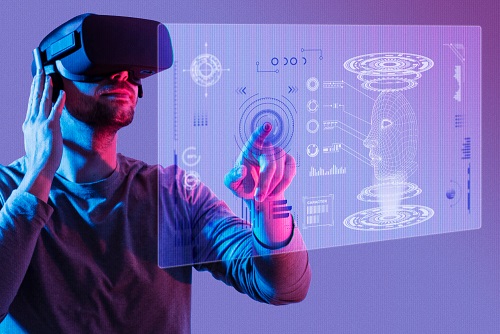
Technology continues to evolve at an unprecedented rate. As a result, innovations like Artificial Intelligence, Virtual Reality, and Machine Learning now bridge the gap between the real and digital worlds, fueling the growth of the digital ecosystem. Among these advancements, Augmented Reality (AR) stands out as a powerful engagement tool that is revolutionizing mobile app development.
Although the term ‘Augmented Reality apps’ may sound futuristic, users are embracing the technology much faster than expected. Initially, AR gained popularity in entertainment. However, it now thrives in various sectors such as e-commerce, healthcare, architecture, education, and real estate.
What is Augmented Reality?
Augmented Reality (AR) refers to a technology that overlays computer-generated virtual information onto the real world. Therefore, it enhances the user’s perception of reality by blending real and virtual elements in real-time.
In the realm of e-commerce, AR grabs attention and helps businesses elevate their customer service. It leverages multimedia, real-time tracking, 3D modeling, intelligent interaction, and sensing technologies to enrich the real world. Consequently, it improves the overall customer journey.
Moreover, modern smartphones play a key role in making Augmented Reality accessible. These devices use cameras, GPS, accelerometers, and sometimes even LiDAR sensors to interact with the physical environment. Meanwhile, platforms like ARKit (for iOS) and ARCore (for Android) simplify the development process. They provide tools for plane detection, lighting estimation, and facial tracking, allowing developers to build immersive AR features without starting from scratch.
Types of Augmented Reality
Today, Augmented Reality appears in multiple forms, each offering unique possibilities. Let’s explore the most common types:
1. Location-Based AR
This type uses the device’s GPS and sensors to place virtual content based on the user’s real-world location. For example, a traveler can use an AR map app to discover nearby attractions. As a result, apps can offer more personalized and context-aware experiences that feel intuitive and engaging.
2. Projection-Based AR
In this form, digital images and lights are projected onto physical surfaces. Users can interact with the content by touching or gesturing in the projection area. Although it’s simple, this type enables highly interactive and tactile experiences, making it ideal for product demos and education.
3. Superimposition-Based AR
Superimposition AR replaces part or all of an object’s view with an augmented version. For instance, in medicine, doctors can superimpose an X-ray image over a patient’s body to gain better insights into an injury. Consequently, it improves diagnostic accuracy and enhances decision-making.
4. Recognition-Based AR
This AR type relies on image recognition to identify objects or patterns in the real world. Once identified, it overlays relevant digital content. As a result, users receive context-aware data instantly, which proves especially useful in product scanning and education apps.
Ultimately, AR bridges the digital and physical worlds, offering people an enriched and interactive way to experience their surroundings.
Popular Use Cases of Augmented Reality in Mobile Apps
Thanks to its versatility, Augmented Reality finds applications in a wide range of industries. Here are some of the most impactful use cases:
- Retail & E-Commerce: Users can virtually try on clothes, test makeup, or preview furniture in their homes before buying. As a result, brands like IKEA, Amazon, and Sephora boost customer confidence and reduce product returns.
- Gaming: AR-based games like Pokémon GO blend real-world exploration with digital elements, turning ordinary places into interactive game zones. Therefore, users stay engaged longer and enjoy a more immersive experience.
- Navigation & Travel: Travel apps overlay directions and historical facts in real-time as users explore a city. Consequently, sightseeing becomes more informative and enjoyable.
- Education: AR revolutionizes learning by allowing students to visualize complex subjects like anatomy, geography, or physics in 3D. For example, a student can explore the solar system interactively. Thus, AR makes learning more effective and engaging.
- Home Improvement & Interior Design: Apps let users preview layouts, test paint colors, and visualize décor changes virtually. This significantly reduces guesswork and helps avoid costly design mistakes.
- Healthcare: Surgeons use AR for precise navigation during procedures. At the same time, therapists employ AR for guided rehabilitation, while patients benefit from real-time health tracking. Therefore, it elevates both treatment accuracy and patient experience.
- Real Estate: Potential buyers can take virtual tours, visualize furniture in empty spaces, and view interactive floor plans. As a result, they make more informed and confident decisions.
Key Industry Developments in Augmented Reality
As demand grows, companies continue investing in AR to unlock new opportunities. For example, in April 2024, Microsoft introduced new AR tools in its Teams mobile apps to support frontline workers. Through Spatial Annotations in Dynamics 365 Remote Assist, teams can provide real-time guidance directly on a user’s video feed.
Furthermore, at CES 2022, Qualcomm announced a collaboration with Microsoft to develop lightweight AR glasses. Together, they aim to accelerate the adoption of AR by integrating Microsoft Mesh and Snapdragon Spaces™ XR Developer Platform. These partnerships demonstrate rising confidence in AR’s role across consumer and enterprise sectors.
Challenges in Augmented Reality App Development
Despite its benefits, AR app development presents a few notable challenges:
1. Location Tracking Limitations: AR experiences rely heavily on accurate positioning. However, in densely populated or indoor environments, GPS often struggles to deliver precise location data. Therefore, developers must explore alternative methods such as Wi-Fi triangulation or beacon-based tracking to improve performance.
2. Privacy Concerns: Since AR apps access the camera, location, and potentially sensitive personal data, privacy becomes a major concern. Developers must implement strict data protection protocols. In addition, they need to clearly communicate privacy policies to users in order to build trust and ensure compliance with regulations.
Tools & Platforms for Augmented Reality App Development
To overcome these challenges, developers can leverage a range of platforms and tools:
- ARKit (Apple): Best suited for iOS development, it offers face tracking, scene understanding, and LiDAR integration on newer devices.
- ARCore (Google): Designed for Android, it provides lighting estimation, environmental understanding, and cloud anchors for shared AR experiences.
- Unity: A powerful engine that supports ARKit, ARCore, and Vuforia. It excels at building real-time 3D simulations and interactive games.
- Vuforia: Known for its strong image recognition and 3D object tracking. Developers often use it in industrial, marketing, or educational AR applications.
- 8thWall (WebAR): This tool enables AR experiences to run directly in browsers without requiring app downloads. Thus, it is ideal for marketing campaigns and event promotions.
By selecting the right platform, developers can simplify the process and focus on building engaging, high-performing AR experiences.
Conclusion
Augmented Reality has moved well beyond a tech buzzword. Today, it delivers real value, enhancing user experiences, increasing engagement, enabling smarter decisions, and deepening brand loyalty. As industries continue to adopt AR, its influence on mobile app development will only grow.
Developers must remain aware of the challenges, including hardware fragmentation, privacy concerns, and performance optimization. However, with powerful tools like ARKit, ARCore, Unity, and Vuforia at their disposal, they can confidently build next-gen AR applications.
In conclusion, if your goal is to stay competitive in the evolving digital landscape, now is the perfect time to harness the transformative power of Augmented Reality.