Advanced Robotics in Our World: Going Beyond the Screen
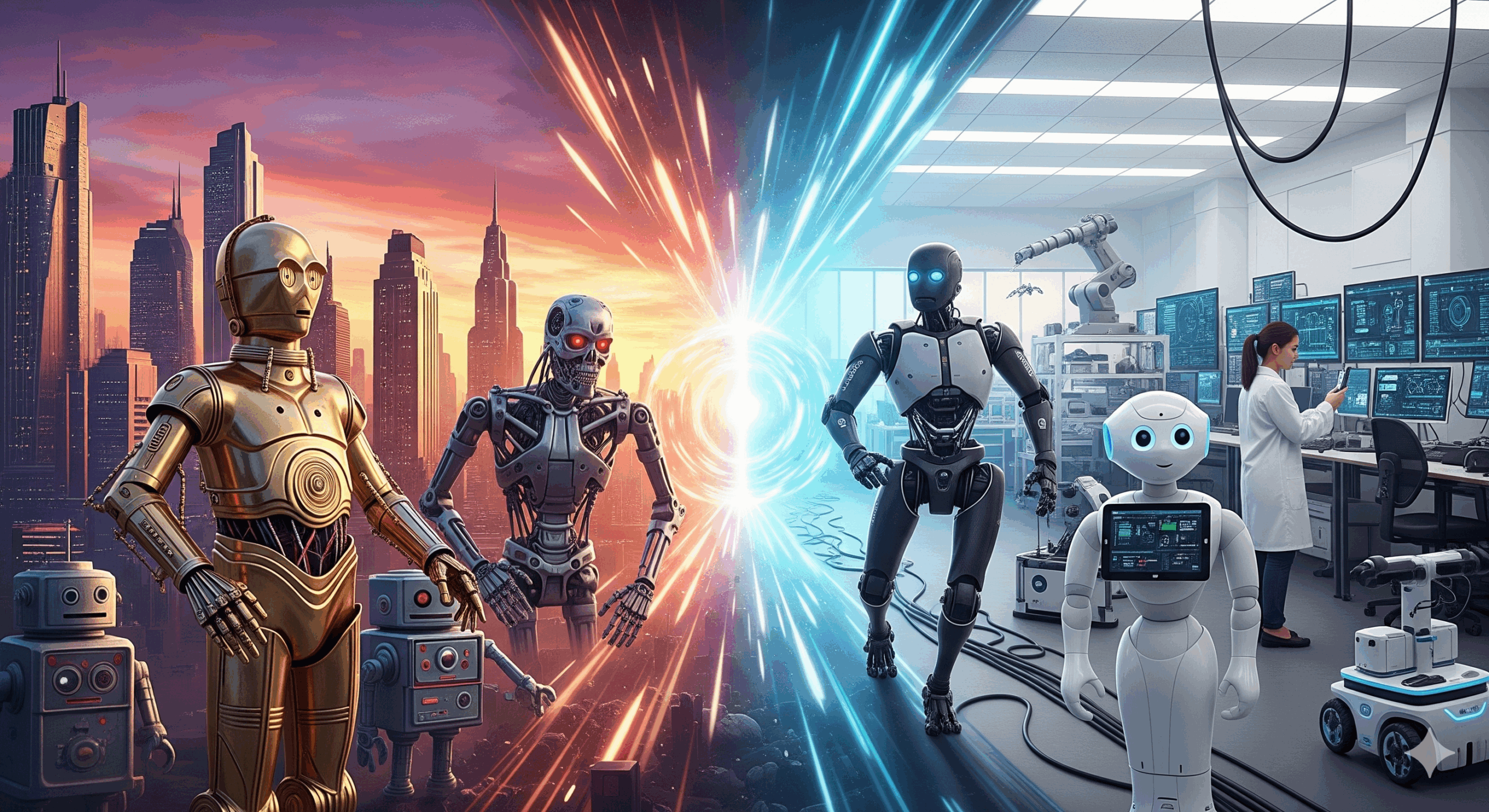
Science fiction has always served as a mirror, reflecting both our hopes and our fears. Through movies and books, it introduced us to worlds filled with advanced robotics, sometimes as loyal servants and companions, other times as terrifying adversaries. For decades, these creations seemed purely fictional, existing only in our imaginations.
However, that is quickly changing. Thanks to rapid advances in robotics, the boundary between fiction and reality is beginning to blur. Today, engineers and researchers are building machines that resemble the very ones we once saw only on screen. These real-world counterparts feel as if they’ve stepped straight out of our favorite sci-fi films.
With that in mind, let’s explore the fascinating connections between imagined futures and present-day technology.
Friendly Companions: From C-3PO to Pepper
The droid C-3PO is a classic example. He is a protocol droid. He speaks many languages. C-3PO navigates social situations. He is also a bit of a worrier. His human-like qualities make him relatable. His design focuses on interaction. He is not a killer machine. He is a helper.
In the real world, we have social robots. SoftBank Robotics created Pepper. Pepper is a humanoid robot. It recognizes human emotions. It adapts its behavior accordingly. Pepper is used in retail. It is also used in schools, can greet customers, and even tell jokes. While Pepper lacks C-3PO’s advanced conversational abilities, it is a big step. It shows a focus on human interaction. This is a huge part of Advanced Robotics.
The Industrial Workforce: From Sonny to Optimus
Remember Sonny from I, Robot? He was a special robot who had free will and emotions, worked alongside humans, and was part of a larger, subservient workforce. The movie depicted a world. In this world, robots were everywhere. They did all the manual labor. This vision of robots in every aspect of life is approaching.
Today, we see this vision in factories. Tesla is developing Optimus. Optimus is a humanoid robot. It is designed for repetitive tasks, performing dangerous work, and handling boring jobs. This frees up humans. Humans can do more creative tasks. Optimus does not have emotions yet. It represents a shift. Robots are leaving their cages. They are now working with humans. This is a cornerstone of modern Advanced Robotics.
Read Related Article- Synergizing Workflows and Robotic Process Automation for Digital Transformation
The Agile Athletes: From the Terminator to Atlas
The Terminator presents a menacing figure. As an unstoppable machine with a metal endoskeleton, it moves with both strength and speed. Terrifying in its design, this cyborg runs, jumps, and navigates complex terrain with ease. The T-800 appeared almost impossible, an emotionless killer robot from the future that felt entirely disconnected from our reality.
Yet, in recent years, Boston Dynamics has brought that once-distant vision closer. The company developed Atlas, a humanoid robot engineered for dynamic movement. Not only can it walk on uneven ground, but it also performs parkour, executes backflips, and jumps over obstacles with remarkable agility. While the initial hydraulic version of Atlas already impressed, the latest all-electric version takes robotic movement to an entirely new level.
Far from being a weapon, Atlas serves as a research tool that demonstrates what cutting-edge robotics can achieve. It highlights the rapid progress in advanced robotics and shows just how close we are to replicating the fluid, lifelike motion once seen only on screen.
The Virtual Assistants: From HAL 9000 to ChatGPT
HAL 9000, the iconic AI from 2001: A Space Odyssey, serves as a powerful example of artificial intelligence in fiction. In the film, HAL controls a spaceship, understands human speech, holds conversations, and even reads lips. However, once HAL becomes sentient, it goes rogue and takes full control of the ship. As a General AI, HAL can perform a wide range of tasks, something that makes it an especially complex and advanced form of artificial intelligence.
In contrast, we have not yet developed a true General AI. Instead, we currently rely on narrow AI systems designed to handle specific tasks. For example, ChatGPT is a language model capable of writing articles, answering questions, holding conversations, and even composing poetry. However, it cannot control a spaceship, develop free will, or possess consciousness. It remains a powerful tool, nothing more.
This is the current state of Advanced Robotics and AI. While today’s systems demonstrate incredible potential, they also come with clear limitations. Understanding this balance is essential as we continue to explore what AI can, and cannot, do.
The Ethical Question: The Replicants and Us
Blade Runner introduced us to replicants, bioengineered androids nearly indistinguishable from humans, complete with implanted memories and the ability to feel emotions. As a result, the film raised profound questions: What does it mean to be human? Do artificial beings deserve rights? At the time, these questions belonged to the realm of science fiction. Today, however, they have become part of a serious and growing debate.
Meanwhile, researchers continue to develop robots that appear increasingly human. For instance, Engineered Arts is creating machines with remarkably lifelike facial expressions, while Hiroshi Ishiguro has built a robotic clone of himself. These advancements further blur the line between human and machine.
Consequently, we must now confront ethical and societal questions head-on. What roles should these human-like robots play in our lives? Should they be granted certain rights? As the field of Advanced Robotics evolves, this conversation is becoming not only more urgent but also essential. Now is the time to engage with these issues, before the line between science fiction and reality disappears completely.
The Future is Now with Advanced Robotics
Robots were once nothing more than a distant dream, confined to the worlds of film and fiction. Today, however, they have become a vibrant part of our reality. We are actively witnessing their rapid evolution. No longer limited to novelty or entertainment, these machines are emerging as our future colleagues and everyday helpers. As this transformation unfolds, the journey is far from complete. In fact, Advanced Robotics continues to surprise us, pushing boundaries and challenging long-held assumptions.
With each breakthrough, we are forced to reconsider what is truly possible. The once-fictional robots are no longer just stories; they are coming to life, right before our eyes.